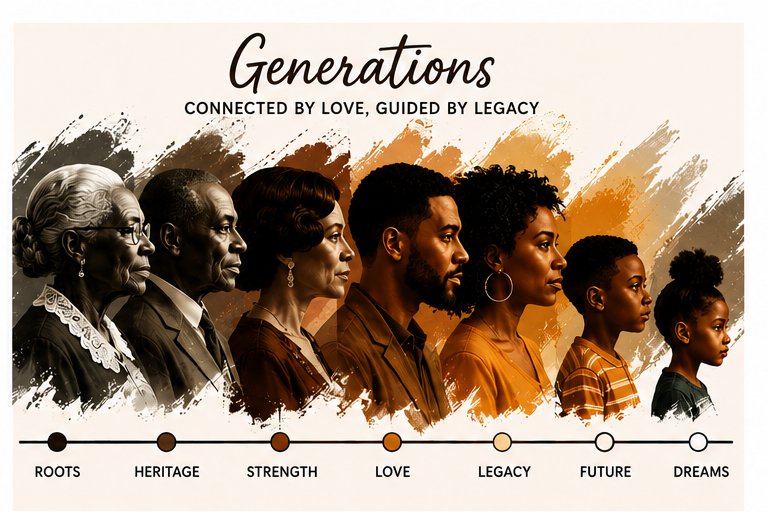
Alpha's Family Line
The Alpha and George Project seeks to preserve not only the lives of Alpha and George, but also the family lines, traditions, values, and experiences that shaped them.
On Alpha’s side, the family story begins with her parents, known within the family as Nana Roman and Pappy Roman, and continues through a remarkable group of siblings whose lives reflected enterprise, craftsmanship, education, migration, community service, and family advancement.
Much of this account is drawn from personal memory, family recollection, and stories passed down through the generations. Some details will require further documentation, confirmation, and contributions from other members of the family.
Nana Roman
Alpha’s mother was known as Nana Roman.
She was a beautiful Black woman, a kind and loving mother and grandmother, and an entrepreneur in her own right. She operated a full-time shop in the Cross Roads Market area of Kingston, Jamaica.
At that time, public markets were central to daily commerce and community life. Cross Roads was considered an important uptown shopping district, and maintaining a steady business there required discipline, consistency, sound judgment, and an ability to work closely with customers.
Nana Roman was remembered as a dependable businesswoman who maintained her place in the market over time. Her shop reflected not merely a means of earning a living, but also the entrepreneurial spirit that would continue through later generations of the family.
I was fortunate to know her. I remember her as a very kind woman who was especially loving toward her grandchildren.
There is a family belief that the word “Nana” placed before a person’s name may suggest royalty or high standing. Whether or not that belief can be historically documented, it reflects the way we regarded her.
To us, Nana Roman was truly royal.
Her dignity, strength, beauty, kindness, and entrepreneurial character made her a central figure in the family.
Pappy Roman
Alpha’s father was known as Pappy Roman.
He died before my birth, so I never had the opportunity to meet him personally. However, I heard many stories about him and the respect he commanded as a skilled builder and craftsman.
Pappy Roman was reputed to have been a master mason, with particular expertise in the construction and repair of churches.
Family accounts indicate that he performed major repair work on the Kingston Parish Church in downtown Kingston. He was also said to have been one of the principal builders involved in the construction or development of St. Luke’s Anglican Church in the Cross Roads area.
These accounts should, where possible, be investigated through church records, parish histories, building records, newspaper archives, and family testimony.
His work suggests that he possessed a high level of technical skill. Church construction and restoration demanded precision, patience, durability, and an understanding of both structural and decorative masonry.
Although I did not know him directly, Pappy Roman’s reputation as a master builder remained part of the family’s understanding of its history.
Through his craftsmanship, he helped build institutions that served communities and endured across generations.
The Children of Nana and Pappy Roman
Alpha grew up as part of a family that included several siblings. Each followed a different path, but together their lives reveal patterns that would remain important throughout the wider family:
- entrepreneurship;
- skilled craftsmanship;
- education;
- migration;
- professional advancement;
- family assistance;
- community leadership;
- and the effort to create opportunities for the next generation.
Stanford Roman
One of Alpha’s brothers was Stanford Roman.
In Jamaica, Stanford worked as a cigar maker. He was reputed to have been an accomplished athlete and was also known for exceptional skill and speed in his trade.
According to family accounts, Stanford took great pride in saying that he was one of the fastest and most accurate cigar makers in the Jamaican factory where he worked.
Cigar making was a skilled occupation. It required concentration, coordination, speed, consistency, and careful attention to detail. Stanford’s success in that work demonstrated both discipline and manual dexterity.
He later migrated to the United States and continued working as a cigar maker. However, his ambitions extended well beyond the occupation in which he had first established himself.
While working, he earned his high school equivalency certificate. He then attended the City College of New York, where he completed a bachelor’s degree.
Afterward, he entered Meharry Medical College’s School of Dentistry and earned his dental qualification. He reportedly graduated as a dentist at approximately 40 years of age.
His journey from cigar maker to dentist was an extraordinary achievement.
It demonstrated that education could be pursued at any stage of life and that migration, hard work, discipline, and persistence could open entirely new possibilities.
After qualifying, Stanford established a successful dental practice in Harlem. He became an influential member of the Harlem community and also acquired real estate.
His life reflected the transition from skilled labor to professional achievement, business ownership, property ownership, and community standing.
Stanford was also known for his support of Jamaica’s independence movement. He had a relationship with Norman Manley and was said to have supported Manley and the movement for Jamaican self-government and independence.
Family recollection holds that Norman Manley stayed with Stanford in New York during some of his visits while traveling between Jamaica, New York, and London.
This connection should be explored further through family records, correspondence, photographs, immigration documents, political archives, and the papers associated with Norman Manley and the Jamaican independence movement.
Stanford also played an important role in helping other members of the family migrate to the United States. Through advice, sponsorship, assistance, or practical support, he helped create pathways for relatives to establish themselves abroad.
In this way, his contribution extended beyond his own success. He became an important link in the family’s migration and advancement.
Sanford “Buddy” Roman Jr.
Stanford had one son, Sanford Roman Jr., who was known within the family as Buddy.
Buddy continued the family’s professional and educational advancement by becoming a medical doctor and medical administrator.
He later became a senior leader associated with the medical school connected to the same City College where his father had earned his bachelor’s degree. The exact institutional title and chronology should be confirmed for the permanent archive.
Buddy was married three times and had several children. At present, the wider family is not in regular contact with those descendants.
An important goal of the Alpha and George Project should be to identify and reconnect with Buddy’s children and grandchildren so that this branch of the family can be restored to the larger family record.
Gladys Roman Goffe
Alpha also had a sister named Gladys.
Family accounts suggest that Gladys may have been raised as an adopted child or may have been a child of Pappy Roman born outside his marriage. This information remains based on family recollection and should be handled with sensitivity unless additional documentation or testimony becomes available.
Whatever the circumstances of her birth, Gladys was fully incorporated into the Roman family and was accepted and loved as a member of the family.
She was remembered as a lovely woman.
Gladys was lighter-skinned than many of the other family members, but this difference did not weaken her relationship with Alpha. Gladys and Alpha were very close and maintained a warm and affectionate sisterly bond.
Gladys married Ernest Goffe.
They had two sons:
- Courtney Goffe, who was approximately the same age as Karl Rodney
- Leighton Goffe, who was somewhat younger
The family later migrated to the United States and eventually moved to Florida.
Over time, contact with Courtney and Leighton was lost. Re-establishing communication with them or their descendants should become another important objective of the family-reconnection effort.
George “Uncle Master” Roman
Another of Alpha’s brothers was George Roman, who was known within the family as Uncle Master.
George was an entrepreneur and a man of initiative.
At one stage of his life, he migrated to Costa Rica, where he had a son named Winston.
George later returned to Jamaica and established a funeral home known as Roman and Dennis. It was reportedly among the earlier Black-owned or locally operated funeral establishments in Kingston and became a successful family enterprise.
The funeral business required dignity, trust, organization, sensitivity, and strong community relationships. George’s success in that field reflects his entrepreneurial ability and his standing within the community.
He later returned to Costa Rica and brought his son Winston to Jamaica.
Winston “Little Winston” Roman
Winston lived with our family for a period of time.
Because my brother was also named Winston, the family distinguished between the two by referring to George’s son as Little Winston and my brother as Big Winston.
Little Winston became an electrician and remained closely connected to the family.
He later became involved in the funeral business and eventually assumed responsibility for its operation, carrying forward the enterprise established by his father.
Winston Roman Jr.
The business subsequently passed to Winston Roman Jr., who has continued and expanded the funeral-home operation.
Winston Jr. has several children. Their names, biographies, and family connections should be added as the Alpha and George Project develops.
This branch of the family represents an important example of intergenerational enterprise: a business established by one generation, continued by the next, and expanded by the generation that followed.
Clifford Roman
Another of Alpha’s brothers was Clifford Roman.
Clifford worked as what was then commonly called a practical dentist. He made dentures, bridges, plates, and other forms of dental prosthetic work.
Although he may not have held the same formal dental qualification later achieved by Stanford, Clifford possessed specialized technical skills and served people who required practical dental care.
He was also a talented violinist and was known to play the instrument very well.
There was an expectation that I would follow in his footsteps musically and that Clifford would teach me to play the violin.
However, as a child, I resisted.
At that time, most of the occasions on which I saw or heard the violin being played were funerals. I therefore associated the instrument with sadness, mourning, and depression. Because of that association, I did not want to pursue it.
As a result, Clifford and I never fully came together around the violin, and the opportunity for him to teach me was lost.
Looking back, this recollection is both personal and instructive. It shows how childhood impressions can influence the traditions and skills that are either carried forward or allowed to disappear.
Clifford’s musical ability should nevertheless be remembered as part of the artistic tradition within the family.
Roy Roman
Clifford had a son named Roy Roman.
Roy became an electrician and was known as a successful and capable tradesman.
Roy later had a child whose name and additional family information remain to be added to the record.
A Family of Builders
The Alpha branch of the family was, in many ways, a family of builders.
Pappy Roman built and restored churches.
Nana Roman built a business and sustained a presence in the Cross Roads Market.
Stanford built a new life through education, dentistry, real estate, political engagement, and assistance to migrating relatives.
Gladys helped sustain the bonds of family affection and continuity.
George built a funeral enterprise that passed through several generations.
Clifford worked with his hands as a practical dentist and expressed himself through music.
Their children became doctors, administrators, electricians, entrepreneurs, and business operators.
Some built with stone and mortar.
Some built businesses.
Some built professional careers.
Some built pathways of migration.
Some built community institutions.
Some built family connections.
Together, they created an inheritance of skill, ambition, enterprise, education, resilience, and service.
Preserving the Record
This account represents an initial effort to preserve the antecedents of Alpha’s family line from memory.
It should not be considered complete.
The next stage of the Alpha and George Project should seek to:
- confirm names, spellings, dates, and places;
- locate birth, marriage, death, education, migration, and professional records;
- obtain photographs of Nana Roman, Pappy Roman, Alpha, and the siblings;
- identify surviving descendants;
- record interviews with older relatives;
- document the history of Roman and Dennis Funeral Home;
- investigate Pappy Roman’s reported work on Kingston Parish Church and St. Luke’s Anglican Church;
- confirm Stanford Roman’s education and dental career;
- document his relationship with Norman Manley and the Jamaican independence movement;
- clarify Buddy Roman’s medical and administrative career;
- reconnect with the descendants of Gladys, Buddy, Roy, Winston, and the other family branches;
- create a complete Roman family tree.
Where facts remain uncertain, the archive should distinguish carefully between verified history, family recollection, and family tradition.
But uncertainty should not prevent us from recording what is remembered.
Memory is often the beginning of history.
By placing these recollections into the Alpha and George archive, we preserve the lives of those who came before us, recognize the foundations they established, and provide future generations with a clearer understanding of where they came from.
The Alpha family story is a story of enterprise, craftsmanship, education, migration, professional achievement, community commitment, and family advancement.
It deserves to be remembered, documented, and passed forward.